Rubricator
Introduction
Communication Channels
Theoretical Framework
Analysis
Conclusion & Recommendations
List of literature and sources of images
Introduction
A niche business is not built on random customers — it is built on a community. The store «28oi» sells comics, figures, and collectible cards — products that people will not buy without interest and trust. For such a store to survive for 17 years and become the oldest in Russia, its audience must keep coming back and feeling that they are part of something of their own.
In this project, we analyze how «28oi» uses communication to create that sense of belonging.
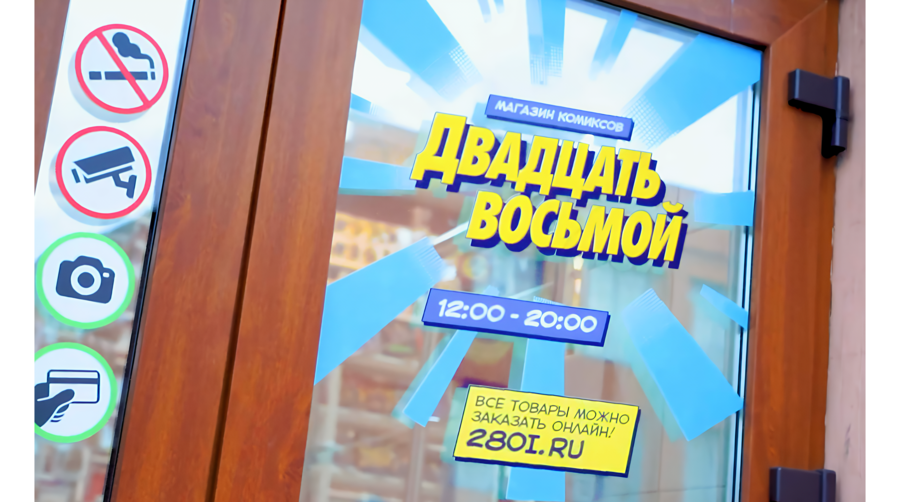
Store on Borovaya Street, 52B, Saint Petersburg

The store was founded by Mikhail Bogdanov in 2009. It started with the publishing house «Komilfo» and a small outlet at the Krupskaya House of Culture. Then, due to requests from customers from other regions, an online store appeared. Only after that came the full offline store on Borovaya Street, 52B in Saint Petersburg.
In other words, «28oi» did not enter a ready-made market — it grew together with its audience.
The positioning of «28oi» rests on three elements:
- The status of the oldest store — trust and a sense of reliability.
- Staff knowledge — the employees understand comics and are ready to help those who know nothing about them.
- Atmosphere — the store is designed as a geek space: graffiti, display cases with figures, bright colours.
Together, these create the image not simply of a retail outlet, but of a place that people want to return to.
Logo of «28oi»
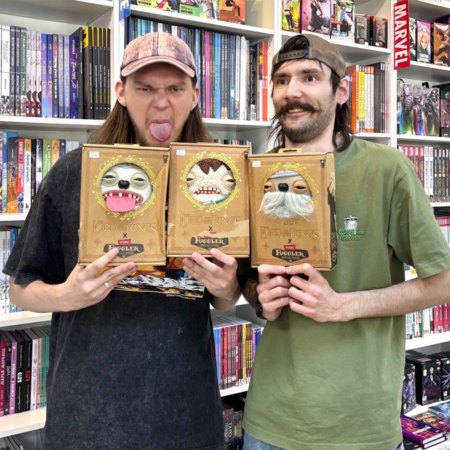
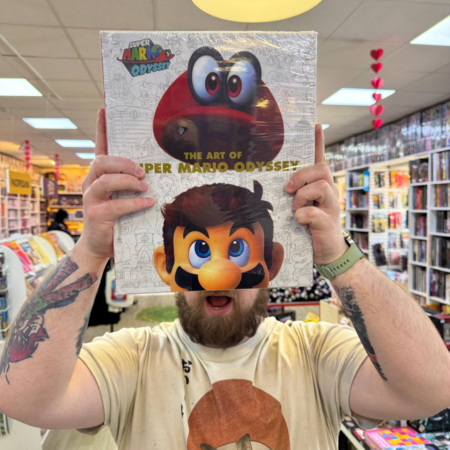
Store staff
The audience of «28oi» is the geek community. Collectors, regular customers, regional clients, people looking for unusual gifts, teenagers and adults — they are united not by age or income, but by an interest in geek culture that becomes part of their identity.
One can buy a comic anywhere. But through its communication, «28oi» offers a sense of belonging.
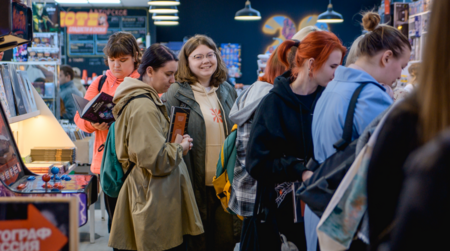
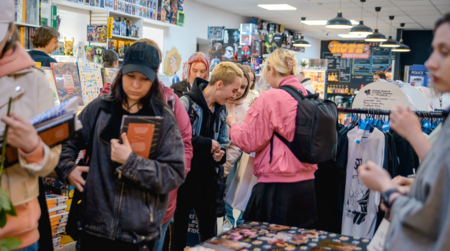
Customers in the store
Communication Channels
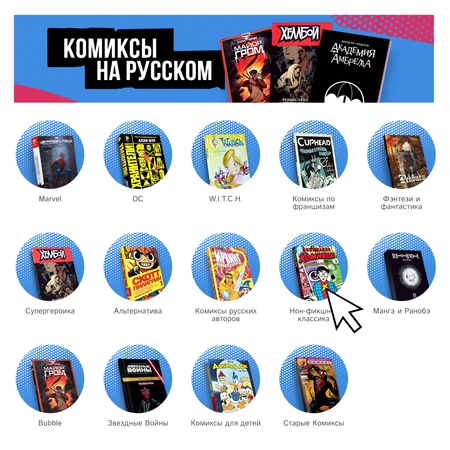
To understand how «28oi» communicates with its audience, one must first look at the tools it uses.
The website is a convenient catalogue that lays out the entire assortment: comics, figures, collectible cards, branded merch, clothing, books, board games. The customer does not need to call or travel across the city — just open the site, find what they need, and place an order. Loyalty points, pre-orders, delivery — everything works to make the purchase as simple as possible for someone who has already decided to buy. This matters because a frictionless website removes barriers between intention and action, turning interest into sales.
Screenshot of the website catalogue

On social media, posts go out several times a day: announcements of new arrivals, pre-orders, promotions, important store news. This keeps the audience informed and ensures they do not miss anything important. In addition, the store replies to questions in direct messages — quickly, to the point, but also lively and human. This removes uncertainty and helps customers decide to buy. From a communication perspective, this builds trust and shortens the distance between the brand and its audience.
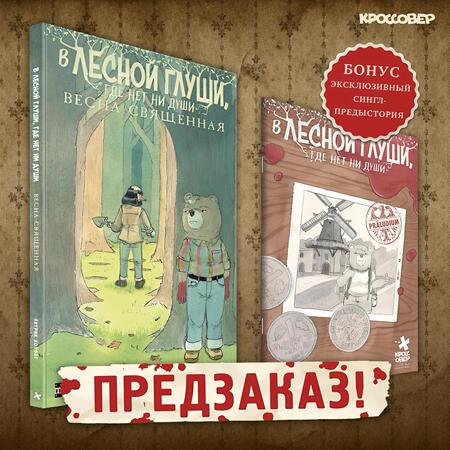
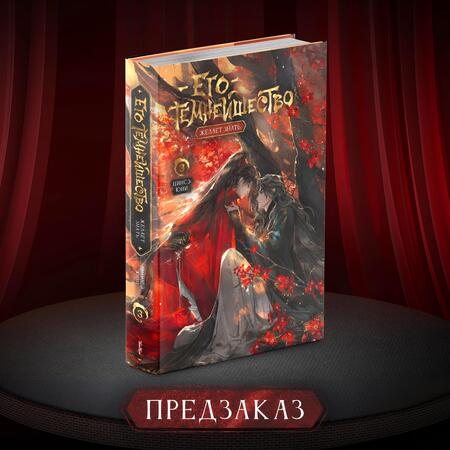
Pre-order announcement

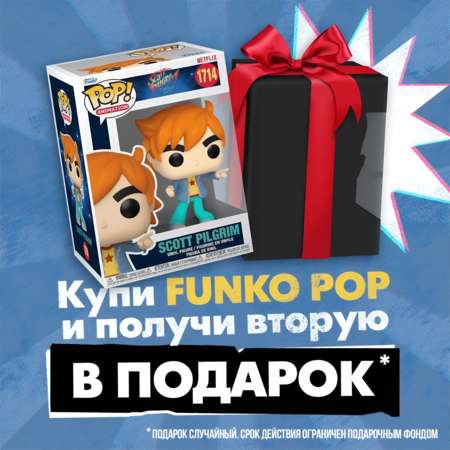
Promotion and discount announcement
Three customer dialogues The store replies warmly, with humour, and honestly — building trust and shortening the distance between the brand and its audience
(«Hello, my beloved customer!»)
The store responds sensitively to trends. The popularity of anime brings manga and figures into the assortment. Blind boxes are trending — «28oi» offers them. Customers ask about something new — the store tries to bring it in. This is not just about following trends, but about listening to demand and adapting quickly. Responding to trends signals that the brand is part of the same cultural moment as its audience.
Thus, through its website, social media, and responsiveness to trends, «28oi» builds a communication strategy that not only informs and sells but also shortens distance and confirms that the brand lives in the same cultural space as its audience.
Social media posts about trendy new arrivals: manga, «Funko POP!» and blind boxes
Theoretical Framework
Why do people return to «28oi» for years? The answer lies not in prices or assortment, but in identity and needs. Two theories help explain this.
The first framework is Social Identity Theory (Tajfel & Turner, 1979). It explains how belonging to a group becomes part of a person’s identity. People divide the world into «us» and «them». Comic fans, collectors, and geeks want their group to look good, so they choose brands that support their identity. This lens fits «28oi» well because the store does not simply sell comics — it offers a sense of being «among your own».
Individual → Group → Identity
The second framework is Uses and Gratifications Theory (Blumler & McQuail, 1969). It asks not what media do to people, but what people do with media. Applied to a brand, it focuses on the needs that the brand satisfies. For «28oi», these include the need to belong («I am among my own»), the need for uniqueness («I have something others don’t»), and the need for information and entertainment.
Together, these two lenses help us analyze how «28oi» builds a community, not just a customer base.
Needs → Brand choice → Satisfaction
Henri Tajfel, John Turner, Jay Blumler, Denis McQuail
Analysis
Group 1. First contact: visual and verbal signals
The store interior is the first thing a visitor sees: shelves packed with comics and figures, display cases with collectibles, pop culture references in the decoration. It looks like a classic comic shop — the kind fans imagine when they think of such a place. The website and social media follow the same visual style: bright colours, speech bubbles, comic aesthetics, pop‑art references.
The unity of the visual language works as a signal. Seeing this style, a person understands: this is a place for «us». Anyone who loves comics and geek culture feels a sense of belonging here.