



Duolingo is a digital education brand best known as a language-learning platform. It offers short interactive lessons through a mobile app and website, turning language learning into a daily habit rather than a formal academic process. It was founded in 2011 by Luis von Ahn and Severin Hacker with the mission to make education free and accessible to everyone. Today, it has over 128 million monthly active users, making it the most downloaded education app worldwide.

The main idea of the brand is to make education accessible, simple and engaging. Duolingo positions itself as a free, fun and effective way to learn languages. Instead of presenting learning as something difficult or intimidating, the brand uses game mechanics, bright visuals, rewards and humor to make the process feel easier and more motivating. Duolingo’s values are connected with accessibility, inclusivity, technological innovation and everyday learning. The brand promotes the idea that education should be available to anyone, regardless of location, income or previous experience. This is why Duolingo does not communicate like a traditional school or textbook. It presents learning as something that can fit naturally into everyday life.
Duolingo’s current tagline reflects the brand’s democratic and inclusive approach to education. At the same time, its product promise, «The free, fun, and effective way to learn a language, ” explains how the brand positions language learning: accessible, playful and practical.
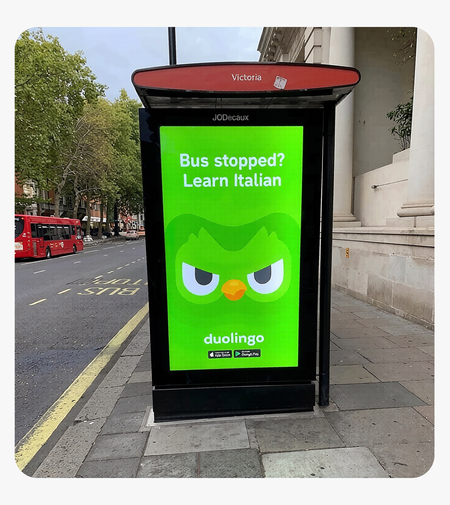
The brand’s mascot, Duo the green owl, has become a cultural icon and an internet character with its own personality far beyond the app. Duo reminds users to study, reacts dramatically when they miss lessons and often appears in memes as funny, obsessive or slightly threatening.
Duolingo’s primary target audience is Generation Z, aged sixteen to twenty-six, along with students and young professionals who value humor, memes, and irony while distrusting traditional polished advertising. Psychographically, this audience wants to feel productive by learning a language but also wants to be entertained without feeling like they are in a classroom, creating what the brand identifies as the «procrastination syndrome.» The key insight driving Duolingo’s communication is that users genuinely want to learn but constantly delay their lessons, and the brand turns this guilt into a shared joke rather than a lecture, as seen in real user comments like «I’m only here for the streak» and «Duo haunts my nightmares.»
Duolingo’s communication strategy is built on a multi-channel approach where each platform serves a distinct function. The website explains the product and its features, the app builds the daily learning habit through gamification, push notifications actively bring users back to maintain their streaks, social media creates visibility and drives virality through memes and trends, and advertising campaigns together with PR events transform the brand into a cultural phenomenon beyond the digital space.
At the core of this strategy lies what can be called «parasocial branding,» where instead of primarily selling a language-learning service, Duolingo sells a character, Duo the Owl, with whom users can form an emotional relationship. The brand speaks the language of Generation Z directly through memes, trending sounds, and absurdist humor, completely avoiding any corporate filter. The key principle is horizontal communication, meaning the brand acts like a friend, an annoying roommate, or even a stalker, rather than vertical communication where a teacher or authority figure talks down to the student. Every post across all platforms reinforces the same chaotic green personality, creating a consistent brand identity that feels personal and relatable rather than institutional or distant.
TikTok is Duolingo’s most important communication channel with over seventeen million followers, where the content is defined by absurd humor, fast cuts, viral sounds, and constant pop culture references, featuring Duo in scenarios such as interrupting celebrity dates, getting plastic surgery, or stalking users who miss their lessons. This version of the brand is called «Unhinged Duo,» a person born specifically on TikTok, where the algorithm rewards high-energy, shareable, and slightly chaotic content, with the goal not to teach anything directly but to maximize shares, comments, and duets. A key case study is the February 2025 «Dead Duo» campaign, where Duolingo appeared to kill off its mascot, causing the internet to react with shock and grief, only to reveal it was a fake death tied to a rebranding, resulting in a forty-nine percent increase in daily active users.
Instagram* works more like a visual showcase. Duolingo cross-posts TikTok videos as Reels but also creates platform-specific carousel posts, which are multiple images users can swipe through and save, turning everyday users into brand ambassadors by sharing content via direct messages, with content including grammar jokes and relatable situations. Instagram* communication is usually more visually polished, but it still keeps the same playful and ironic tone. YouTube gives Duolingo space for longer formats. The brand can use it for advertising videos, Shorts, explainers, educational content and brand campaigns. Unlike TikTok, YouTube allows Duolingo to combine entertainment with a clearer demonstration of the product.
Duolingo actively creates news through real-world PR stunts and unexpected partnerships beyond digital platforms, such as appearing on the reality TV show Love Island as a «contestant» for one episode where Duo flirted with cast members, creating absurd television moments that were then clipped and shared endlessly on social media. In Indonesia, the brand engaged in a viral billboard war with the e-commerce platform Tokopedia, where the two companies swapped mascots and trolled each other on physical billboards across Jakarta, with one billboard reading «Not Tokopedia. Don’t ask for deals.» The brand also parodied a music video by the singer NIKI, replacing the original lyrics with phrases like «Do your Spanish lesson,» demonstrating that Duolingo insert itself into any cultural moment regardless of medium to generate free media coverage.
The official website is the most rational and informative communication channel. It explains what Duolingo offers and presents the brand promise: language learning that is free, fun and effective. The tone of the website is much calmer than the tone of Duolingo’s social media communication. Its main task is to explain the value of the product and lead users toward starting a course.
The app is the central communication channel of the brand. It is where the user interacts with Duolingo every day. The app uses lessons, XP points, streaks, levels, leaderboards, achievements and rewards to create a sense of constant progress. Communication is not only verbal, it is built into the interface itself. Every animation, sound, icon and reward tells the user: you are moving forward.
Push notifications are one of the most recognizable parts of Duolingo’s communication. They are not neutral reminders. They often sound like messages from Duo. The owl can appear disappointed, sad, dramatic or passive-aggressive. This turns a technical notification into a small emotional scene. The user is not simply reminded to study, but is pulled back into a relationship with the character.
Duolingo’s multi-channel communication strategy succeeds because every channel, from TikTok to billboards, serves a distinct function while all of them are united by the same chaotic and relatable personality of Duo the Owl. The website and app deliver the educational service, push notifications drive daily engagement, social media generates virality and cultural relevance, and PR stunts turn the brand into a real-world phenomenon. What sets Duolingo apart from other educational brands is its commitment to horizontal communication, treating users as friends or annoying roommates rather than students to be lectured.
By selling a character rather than just a service, Duolingo has transformed a language-learning app into a pop culture icon that young users actively want to engage with, share, and even meme about, proving that in the age of Generation Z, personality and humor can be more effective marketing tools than traditional educational messaging.
Why do users choose Duolingo? The U&G theory holds that audiences actively seek media to satisfy specific needs. U&G is highly relevant to Duolingo because the brand’s entire ecosystem app design, social media posts, push notifications is engineered to satisfy several user needs at once. Users do not stumble across Duolingo content passively they actively seek it out, share it, and build culture around it.
Habit & Routine Daily streaks and push notifications create a ritual of opening the app users satisfy their need for structure and self-improvement.
Education Users seek cognitive gratification language skills and cultural knowledge. Duolingo frames learning as measurable progress. Entertainment Memes, the sassy owl persona and humorous notifications blur the line between entertainment and education edutainment.